Comparing Role-Based and Skill-Based Agentic AI Architecture for Enterprise
Organizations today are racing to put AI to work — not just for answering questions, but for running entire workflows. The industry is shifting from general-purpose chatbots toward "Agentic AI": systems that can think through problems, make plans, and carry out complex tasks end-to-end without human intervention.
But once these systems hit production, a common pattern shows up: the "Closed-System Illusion." Everything runs smoothly in the lab — then falls apart the moment it faces the messy, unpredictable reality of live business operations.
The typical fix is to throw a bigger model at the problem or add more agents to the mix. Neither approach tends to stick, and both drive up costs fast. The real issue isn't that AI lacks intelligence — it's the context management architecture: the way the system stores and passes information while it operates.
This article breaks down how both architectures actually work — the traditional Role-Based approach and the newer Skill-Based approach — and walks through the engineering steps needed to migrate from one to the other while cutting costs and improving performance.
1. Deconstructing the Legacy Framework: Understanding Role-Based Architecture
In the early stages of building automated systems, the most widely adopted method was assigning multiple AI agents to work collaboratively, commonly referred to as "Role-Based Architecture."
This concept mimics human corporate environments by simulating various departments. It assigns clear "roles" and responsibilities to distinct AI agents, tasking them only with specific functions they excel at, much like dividing work among office personnel.
Operational Mechanism of the Role-Based System
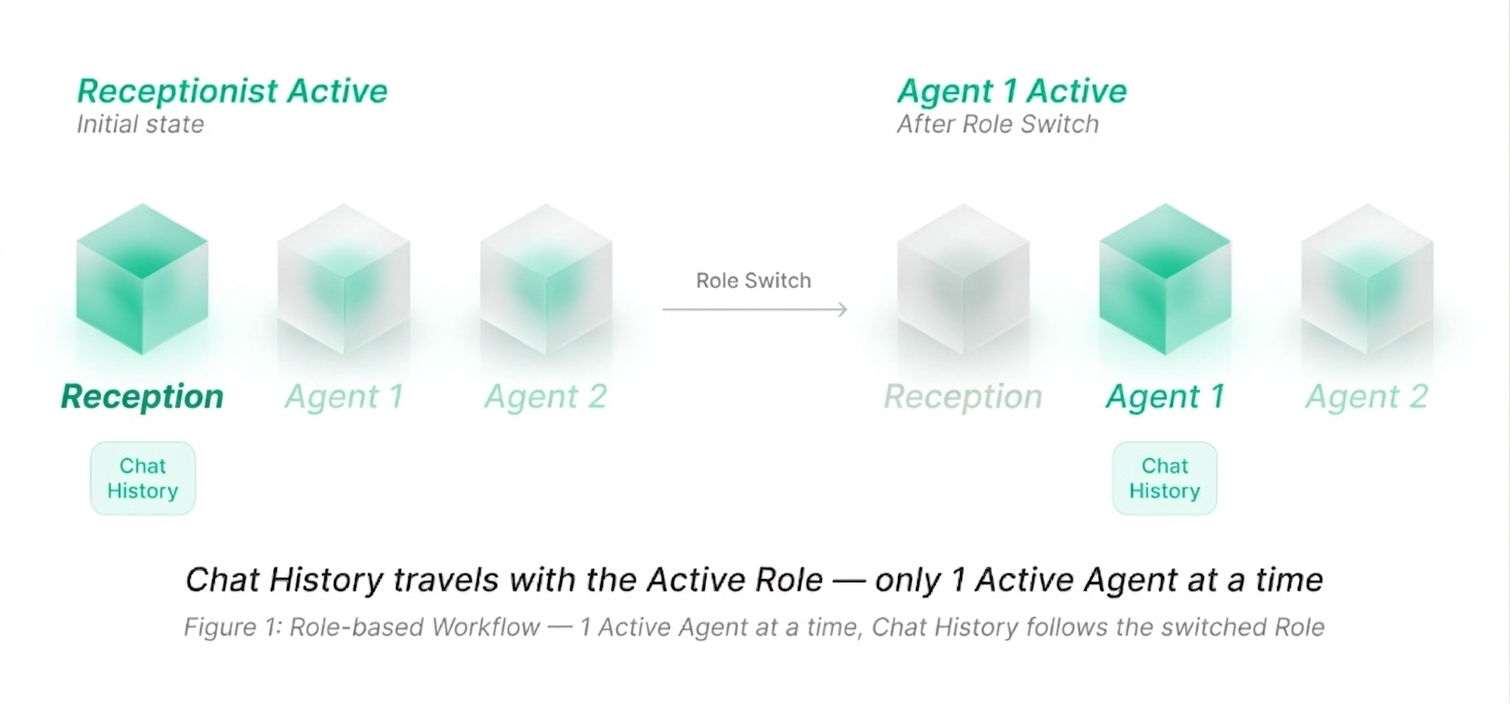
This system operates through a network of AI agents connected by sequential, one-directional task handovers. Typically, the AI network is divided into two main categories:
- Coordinator Agent: Acting as the frontline manager, this agent receives user requests, analyzes the underlying intent, and decides which department should handle the assignment.
- Specialist Agents: These are the departmental experts, such as the billing and invoicing department, technical support, or sales and marketing.
When a user sends a message, the Coordinator Agent picks up the request and decides which Specialist should handle it. It then forwards the entire conversation history to that Specialist as-is, without summarizing, filtering, or restructuring anything.
The Specialist Agent then processes the data on its own to build a response or carry out the required action. It sends the answer straight to the user. Nothing goes back to the Coordinator: no results, no status updates, no feedback. The Coordinator's job is done the moment it hands off the conversation.
Hidden Bottlenecks in the Role-Based System
Splitting work by role looks clean on paper, and it mirrors how human organizations operate. But in practice, routing data through repeated handovers creates three key bottlenecks:
1. Context Loss and Hallucinations
The Coordinator Agent sends the entire raw conversation over without any structure or context framing, so the Specialist Agent has to make sense of the full history on its own. Important details like prior context, emotional tone, or what the user actually needs often get lost along the way. When the Specialist works from this kind of loosely organized data, it becomes prone to "hallucination," where the AI fills in the gaps by guessing or making things up. The result is a response that can be unreliable or completely off-base.
2. Handover Failures and Infinite Loops
When a Specialist Agent receives a large block of unstructured conversation data, it can lose track of what it's actually supposed to do. If the data is too ambiguous to act on, the agent may stall or bounce the request back to the Coordinator for clarification, which triggers another round of handovers. In the worst case, agents keep passing the task back and forth until the system gets stuck in an infinite loop and crashes.
3. Spiraling Compute Costs
Every time a task is handed off, the full conversation history gets duplicated and sent along. Each transfer eats into the system's token budget, and tokens translate directly to cost. The longer the conversation and the more complex the task, the more tokens get burned. Over time, this makes the system expensive and hard to scale.
2. Modern Operational Methodology: Skill-Based Architecture
To get around these problems, AI engineers took a different approach: the "Single-Agent Skill-Based Architecture."
Instead of splitting work across multiple agents, this system keeps everything inside a single AI agent. It focuses on memory management and smart tool use, removing the need for data transfers between agents altogether.
Intelligent Self-Contained Operational Mechanism
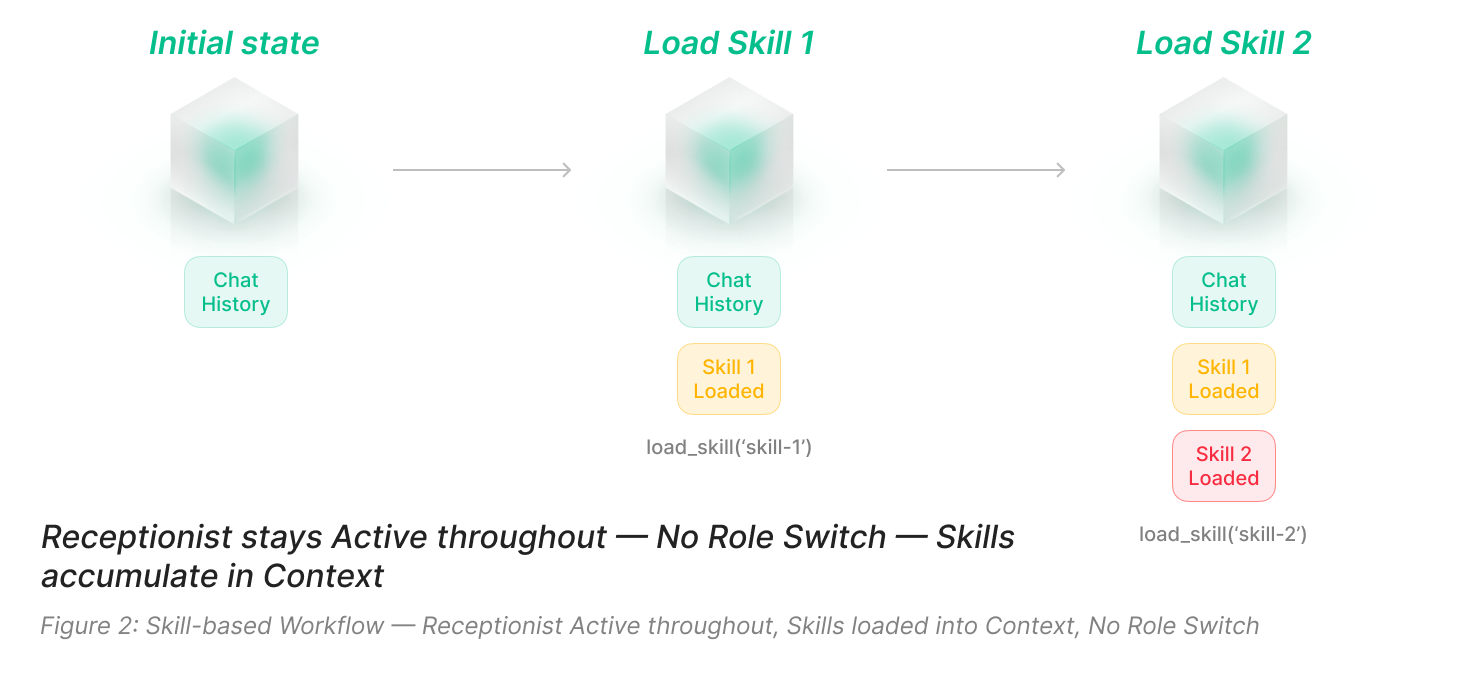
The Skill-Based system runs on a single centralized AI agent. Its key advantage is that it keeps the full conversation history in memory, from the first message to the last, so nothing gets lost during handovers or broken up across agents.
But there's a catch: if the system loads every department's operational manual into the AI's memory at once, it creates "Information Overload." The AI gets confused and starts making mistakes.
The fix is "On-demand Procedural Knowledge Retrieval." When a request comes in, the AI doesn't read every manual. Instead, it scans the titles and summaries to understand what each skill covers.
Once it identifies the right skill, it pulls the full manual for that skill into active memory and follows the procedures step by step until the task is done. The result goes straight to the user.
Think of it like a single skilled mechanic standing in a workshop full of repair manuals. When a customer brings in an antique clock, the mechanic doesn't pass it to another department or try to guess how to fix it. They walk over, grab the right manual, and follow the instructions until the job is done.
The mechanic always has full context of what the customer needs and can work through the problem without getting sidetracked. The result is faster and more accurate.
Summary of Differences
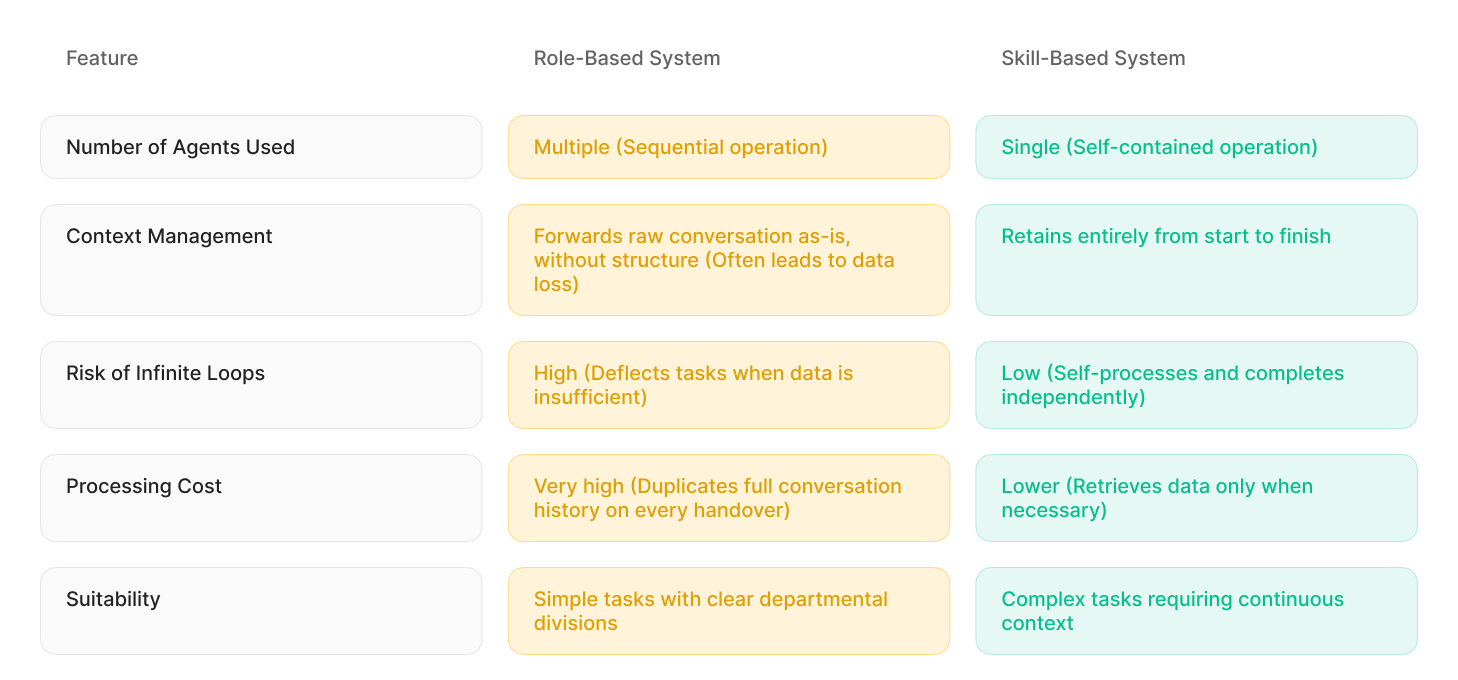
3. Engineering Compilation Methodology
Moving from Role-Based to Skill-Based isn't as simple as deleting the old system and writing new prompts. It takes a structured engineering process.
The goal is to make sure the new system handles business requirements at least as well as the original, while using fewer resources. The process breaks down into three steps:
Step 1: Capability Deconstruction
This phase dissects the original system's broad roles (e.g., acting as an accountant) into smaller, highly granular "Skill Modules" capable of completing tasks independently.
The rule of thumb is that each skill should be explainable in a single sentence: what it does. Just as important, each skill needs clear "Negative Boundaries" that define what it must not do. These limits stop the AI from making assumptions or drifting into unrelated workflows, which cuts down on errors significantly.
Step 2: Backend Function Assignment
The micro-skills are then categorized and appropriately matched with backend operations. They are divided into two main groups:
- Internal Logic Skills: Skills requiring independent logical reasoning, such as language translation, content filtering, or text summarization. The AI language model can process these entirely within its own parameters.
- External Mechanism Skills: Skills relying on external infrastructures, such as querying company databases, pulling data via API systems, or fetching real-time streams.
Categorizing skills in this manner helps the system allocate memory and network connections efficiently, preventing data retrieval bottlenecks.
Step 3: Collapsing Communication Structures
This is the most important part of the transition. In the old system, the Coordinator copied and sent the full conversation to Specialist Agents on every handover. In the new system, that entire communication layer is replaced with "Input/Output Data Constraints" built directly into each skill's manual.
So when one skill finishes, its output plugs directly into the next skill's input, like puzzle pieces fitting together. There's no need to copy and resend the full conversation anymore. Removing that overhead is what makes the system so much more efficient.
4. Quantitative Outcomes: Accuracy, Latency, and Cost
To ground these findings in practice, the metrics below were collected from a production customer service chatbot. Switching to a Skill-Based system is not just conceptually superior in theory; empirical data and clear statistics confirm that it decisively solves the bottlenecks of the legacy architecture across three primary dimensions:
Dimension 1: Accuracy Enhancement
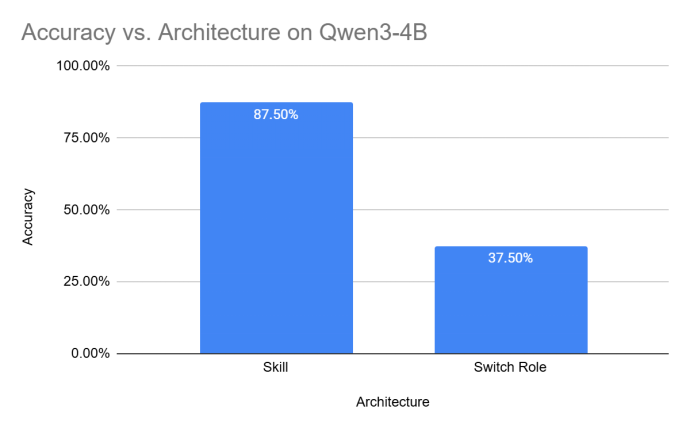
In the old system, smaller models often got confused because they had to juggle complex instructions across overlapping departments. Under the Skill-Based architecture, where the model focuses on one manual at a time, accuracy jumped from 37.5% to 87.5% (a 2.3x improvement). The models were never the problem. The old system just couldn't manage context well enough for them to perform.
Dimension 2: Response Latency
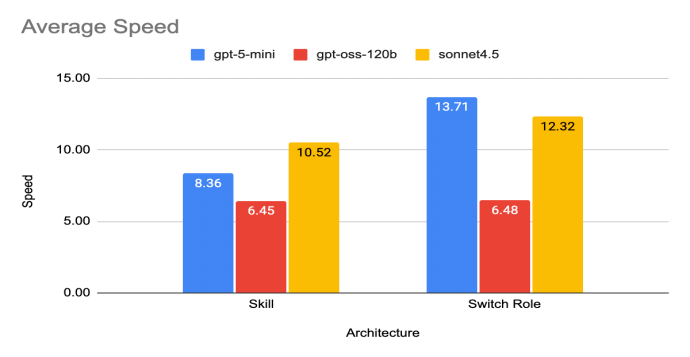
Without the overhead of passing data between agents, response times dropped significantly. Standard enterprise models responded 39% faster (from 13.7s to 8.4s), and high-end models improved by 15% (from 12.3s to 10.5s). These faster response times make a noticeable difference in how smooth the system feels to end users.
Dimension 3: Token and Cost Efficiency
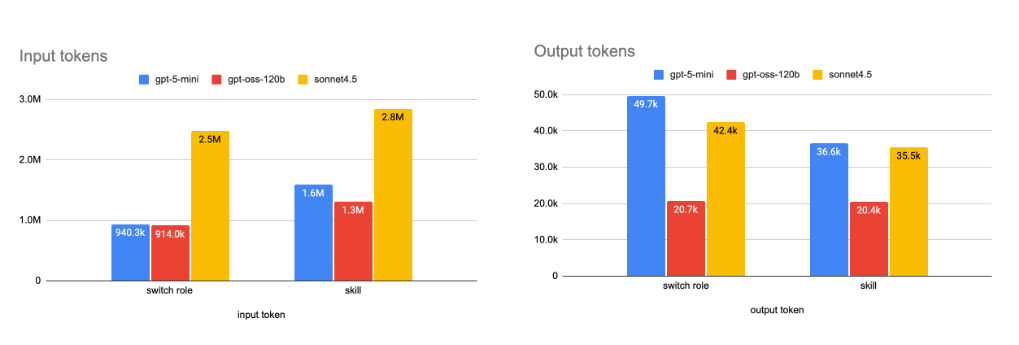
Many developers worried that loading full skill manuals into the prompt would use too many Input Tokens. In practice, the opposite happened: the structured instructions kept the AI focused, so it answered more directly and hallucinated less. Output Token usage dropped by up to 28%, and total operating costs fell by 54%.
5. The Rationale Behind Adopting the Skill-Based Approach
The primary reason for selecting the Skill-Based architecture as a foundational system is its ability to perfectly retain environmental context while maximizing computational resource efficiency, as detailed above.
However, as organizations grow, expanding their systems and adding new "Skill Manuals" from tens into the hundreds or thousands, a new bottleneck emerges. This time, the issue is not data overflow, but rather "Wrong Skill Selection." Because there are so many skills, the nomenclature becomes highly similar, leading to an AI phenomenon known as "Semantic Confusion."
For instance, if a system maintains separate skills for "Invoice Management," "Bill Management," and "Receipt Issuance," their semantic meanings are so closely related that the AI becomes confused. If it misinterprets the intent and pulls the wrong manual, the workflow will fail, and the final answer will not align with the user's original question.
Decoding the Solution with Design (Progressive Disclosure)
To preserve the high performance of the Skill-Based system while entirely eliminating AI confusion, engineers borrowed a concept directly from User Experience design methodologies: "Progressive Disclosure."
In typical software applications, this method hides unnecessary information initially, revealing it only when the user explicitly requires it, thereby preventing visual clutter. When this conceptual framework is mathematically applied to limit the AI's visibility, it becomes an incredibly powerful routing mechanism.
As a simple comparison, executing tasks within a poorly managed system is like buying every conceivable ingredient from the supermarket and stuffing it all into the refrigerator just in case; the environment becomes chaotic, items are lost, and resources are squandered. A smart, architecturally sound system, however, is akin to checking the exact recipe for the day's meal first, noting only the required ingredients, and retrieving exclusively those items. This handles the task accurately without any systemic waste.
Two-Level Filtering Mechanism
To ensure absolute system fluidity, this filtering mechanism is systematically divided into two distinct layers:
Level 1: Main Category Search
In the primary layer, the AI is mathematically prevented from seeing the thousands of granular skills in the library. Instead, it is forced to scan only the large category "labels" to analyze the customer's macro-intent. For example, if a customer asks how to pay, the system actively eliminates marketing promotions or technical support categories entirely, restricting the AI's focus strictly to the "Billing System" category.
Level 2: Skill-Specific Drill-down
Once the AI is correctly routed into the appropriate category, the next layer of data is revealed. Typically, a single sub-category contains a highly constrained list of only 5 to 8 specific skills to choose from. Limiting the choices to this degree completely eliminates semantic confusion. The AI can then evaluate the options and pull the exact operational manual with absolute precision, no longer getting lost in extraneous data.
Through this step-by-step organizational matrix, the system seamlessly hides tens of thousands of complex operational items in the backend. It only reveals critical information to the AI when mathematically necessary. This framework allows organizations to continuously expand their systems and add new capabilities infinitely, all while the AI continues to execute at lightning speed and with uncompromised accuracy.
Conclusion of the Transition
Changing the enterprise architecture from a Role-Based system—characterized by multiple AI agents with redundant data handovers—to a single-agent Skill-Based system operating with a centralized skill library is a ground-breaking discovery in the technology industry.
This evolution serves as clear proof that the primary reason AI frequently fails in the live business world is not that foundational language models are inept or lack sufficient parameters. The decisive factor determining success or failure lies entirely within the underlying "Context Management Architecture."
Eliminating communication chaos, reorganizing operations into rigid input-output data constraints, and managing active memory via the "Progressive Disclosure" strategy does not merely eradicate data loss and generative hallucinations. It dramatically increases system accuracy, slashes latency, and yields massive operational cost savings.
Consequently, the Skill-Based Architecture is not merely a theoretical concept, but the definitive engineering blueprint of the future. It is the framework required to propel AI from a mere laboratory novelty into an ultimate operational assistant, fully capable of managing profound complexity and sustainably driving the real-world business landscape.
Collaborate and partner with our AI Lab at Amity here.